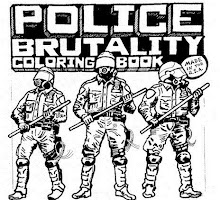
on sale now at amazon

on sale now at amazon
"I don't like this book because it don't got know pictures" Chief Rhorerer

“It’s becoming a disturbingly familiar scene in America - mentally unstable cops”

“It’s becoming a disturbingly familiar scene in America - mentally unstable cops”

Hundreds Protest Against Police Brutality Following Death of Migrant Worker

People gather to protest police brutality
LOUISVILLE, Ky. —A group of people gathered in front of the old City Hall to bring attention to the death of Michael Brown and others Saturday.
Brown was fatally shot by a Ferguson, Missouri, police officer last August.
The group Black Lives Matter organized the event. Hearts were laid on the steps, the building and the sidewalk.
“On these hearts are some of the last words of the police brutality victims, their names, ages, circumstances of their deaths,” said Ashley Belcher, a spokesperson for Black Lives Matter.
Belcher said the demonstration is out of love to remind the community that black lives still matter. She said the movement continues to grow.


Washington Protests 2015: Hundreds Protest Against Police Brutality Following Death of Migrant Worker
By Claudia Balthazar 
Hundreds of children and adults protested against police brutality in Washington Saturday amidst a fatal shooting of a migrant orchard worker in Pasco.
The group demanded justice for Antonio Zambrano-Montes who police killed on Tuesday for allegedly throwing rocks at them, according to The Associated Press.
Some of the large signs during the protest, led by the victim's family, read, "Stop Police Brutality: It was just a rock!!!" "Use Your Training, Not Guns," and "Good Police We Respect You."
The crowd also marched to the location where the shooting took place.
Felix Vargas, chairman of Consejo Latino, a group of primarily Latino business leaders, called for a federal investigation into the shooting while demonstrators demanded a full review of the Pasco police department.
Franklin County Coroner Dan Blasdel will order an inquest. He said the results will be open to the public.
Meanwhile, the victim's family filed a $25 million claim in damages against the city of Pasco, New York Daily News reports.
Police confirmed Friday that Zambrano-Montes, who is also a citizen of Mexico, was not armed during the shooting.
Officials are still investigating the incident where it has been reported that Zambrano-Montes was throwing rocks at the cops before they opened fire. Police say the victim's threatening behavior led officers to shoot him after a stun gun could not calm him.
Mexican President Enrique Pena Nieto reiterated the country is against police using lethal force.
"I have directed the secretary of foreign relations to support his family so they feel the backing and support of the government of Mexico, so they don't feel alone and so there is a close monitoring of the investigation into this regrettable and outrageous occurrence," he said.
Detectives will be interviewing at least 40 witnesses for the investigation and will be reviewing dash-cam video footage.
Three other fatal police shootings in Pasco have been cleared by prosecutors.


Lubbock police officer arrested, charged with paying for sex


LUBBOCK, TX (KCBD) -

A Lubbock Police Officer is now facing criminal charges, charged with a hiring a prostitute. Authorities announced the arrest of Dustin Wayne Hatley on Wednesday morning, following his arrest Tuesday night.
According to police, on Feb. 13, during the course of a separate criminal investigation, authorities received information alleging that an LPD officer was engaging in criminal activity while off-duty. Police say a criminal investigation was immediately opened, and that investigation established probable cause to obtain an arrest warrant.
Police arrested Hatley as he exited a plane around 10:30 p.m. Tuesday.  He was taken to the Lubbock County Detention Center and booked on charges of prostitution and official oppression.
Hatley has been placed on Administrative Leave pending further investigation.
According to the criminal complaint filed Tuesday, Hatley is accused of paying for sex in January of this year. He's also accused of sexually harassing a woman while "acting under the color of his office or employment as a public servant, namely, a peace officer".


The thin line between a cop and a common criminal


Jail releases video of Toledo police lieutenant's arrest
Alexis Means
The Lucas County Jail has released video of a Toledo police lieutenant being booked, and Toledo's police chief is also speaking out. He says the arrest of one of his top lieutenants is an isolated incident.
The police chief says, as soon as the department learned one of their own was allegedly connected to the shooting, he took action.
"This isn't a bad barrel syndrome, it's a bad apple," says Toledo Police Chief George Kral.
Toledo's top cop wants the citizens to know he won't tolerate dirty officers. 
"Police officer or not a police officer, the exact same steps are taken for each person, regardless of what they did for a living," says the chief.
     The department released video of Lt. Frank Ramirez being booked in the jail. Ramirez is the third person arrested in a shooting investigation. He allegedly helped to plot the shooting of a witness who testified in two high profile murder trials.
Johnny Clarke and Lisa Straub were killed in Springfield Township in 2011. Tiffany Williams testified in the case. She was on the phone with Clarke when someone came in the house. Sources tell 13abc Clarke's parents think Williams set up their son.  
    In December, police arrested Johnny's parents Maytee and John Clarke for shooting at Tiffany Williams.
"Approximately at 10:48 pm Tiffany William was walking in the 1300 block of Colburn street. John Clarke chased and discharged a firearm at Ms. Williams," said Chief Kral. Toledo police are tight-lipped about Ramirez's role.
Ramirez is charged with obstructing justice, tampering with evidence and felonious assault.  His lawyer says Ramirez plans to cooperate with police.
   The chief says the case will be presented to the Lucas County grand jury next week.


Fresno police officer charged in stolen car investigation
By Corin Hoggard

FRESNO, Calif (KFSN) --
Criminal charges have been filed for a crime allegedly committed by a Fresno police officer.
Action News reported about Alfred Campos last year when his fellow officers served a search warrant at his house. It was actually the second time Fresno police investigated him for a crime, but this is the first time he's been charged, and he was arrested Tuesday night.
For the second time in twelve months, an Action News reporter found himself knocking on the door of Alfred Campos' home. For the second time, someone was home, but nobody answered.
Campos served 15 years as a Fresno police officer, but between our last visit and now, he lost his job. An arrest warrant filed this week shows the stolen car investigation that brought ABC30 to his door in 2014 led to criminal charges in 2015.
Fresno police arrested Campos Tuesday night and the warrant details why. It all started when Campos took a stolen pickup truck for repairs and mechanics noticed the vehicle identification number (VIN) was bogus. Officers say Campos knew it was a fake because he checked on it twice using the special access he had as a police officer. Legal analyst Michael Aed says that evidence could really hurt.
"That's a really tough hill for Campos to climb if that can be established," Aed said.
Investigators say Campos denied knowing the truck was stolen, despite the fact that he checked the VIN, and he owns an auto repair shop in Central Fresno. The warrant says he told officers he bought the truck from Brian Cruz. Police arrested Cruz Sunday and he admitted stealing the truck in Virginia. He said Campos knew it was stolen and they were working together to buy and sell stolen vehicles. Cruz is also charged with burglary in another case and Aed says Campos may use that as a defense.
"When you're relying on a witness who has some problems with their credibility, that always becomes a problem," Aed explained. "It always raises suspicion as to whether Brian Cruz is a credible witness."
When police served a warrant and found four pounds of meth at Campos' home in 2006, he was not charged with a crime. This time, he had to post a $25,000 bond to stay free. He's scheduled to enter a plea in court next month.


Houston Police Officer Charged With Shoplifting Ammo, Still Has a Job
Was only on the force two months before being caught allegedly stealing ammo, and won't be disciplined until the internal investigation's over.
Ed Krayewski|
DStephen Sargent, an officer with the Houston Police Department (HPD) for less than three months and still considered probationary, was arrested on charges of shoplifting. He's accused of stealing $60 worth of ammunition from a sporting store.  He's been "relieved of duty" but remains employed by the HPD. In fact the department reportedly won't decide how to discipline him until after the internal investigation is complete.
Police officers are entrusted with the power of life and death; they're granted the privilege of using force on behalf of the government and, through that status as government employees granted protections for when they abuse their powers.  Rarely are police officers held accountable for their use of force in questionable circumstances. And even when victims of police brutality win settlements from the police department or city government, such settlements don't affect the police officers. Often they come with specific denials of responsibility for any wrongdoing.
When a police officer has shot and killed someone under questionable circumstances,  even a fair and thorough investigation that might lead to charges won't bring back the dead. Neither can any social movement or hashtag do so, nor does it have the ability to definitively prevent future killings. And the more the problem of police violence is personalized, the harder it is to combat.
If he remains on the force will Sargent ever kill someone in the line of duty? It's impossible to say. But getting caught shoplifting ammo suggests an incredible defect of character, and when the privilege to use deadly force with little accountability hangs in the balance, a zero tolerance approach to bad behavior by cops saves lives and helps ensure we can all get home safe at night.
Ed Krayewski is an associate editor at Reason.com


Former NYPD officer sentenced to prison for fraud, ID theft
NEW YORK - A former officer with the New York City Police Department was sentenced in Manhattan federal court to 28 months in prison for credit card fraud and identity theft.  John Montanez, 28, of the Bronx, New York, pleaded guilty in August 2014 to one count of access device fraud and one count of aggravated identity theft.  In addition to his prison term, he was sentenced to two years of supervised release, and was ordered to forfeit $2,500, and pay a $200 special assessment.
Manhattan U.S. Attorney Preet Bharara said:  “While a Police Officer, John Montanez engaged in credit card fraud and identity theft. As Montanez said on tape, ‘I am not the cop you think I am.’ For certain, he was not the cop the public deserved and not one who deserved to carry an NYPD badge.  By breaking the law, John Montanez not only threatened the safety of others, but also undermined the position of law enforcement as a pursuer of justice. We will continue to actively prosecute cases of police corruption.” 


DPD investigator suspended, subject of TBI investigation
A member of the Dyersburg Police Department has been placed on administrative leave pending the outcome of an investigation by the Tennessee Bureau of Investigation. The officer, Sgt. Cara Johnson-Peckenpaugh, was placed on administrative leave late on Friday, Feb.13 after DPD Chief Steve Isbell was informed by the TBI a criminal investigation was to be launched regarding theft.
"I was informed the TBI was going to begin a criminal investigation into an incident regarding one of our investigators. I placed Sgt. (Cara) Johnson-Peckenpaugh on administrative leave on Friday night," said Chief Isbell. "She will remain on administrative leave pending the outcome of their investigation. At this point, I have to refer saying anything else to the TBI regarding this situation."
When contacted concerning the possible investigation, the TBI did confirm to the State Gazette they were asked to open a criminal investigation involving theft by Obion County District Attorney General Thomas A. Thomas, but couldn't provide any other details.
Johnson-Peckenpaugh has been a member of the DPD workforce since July 8, 2002.

Greensburg police chief faces theft, misconduct counts
GREENSBURG, Ind. (AP) —A former Greensburg police chief who investigators say has a gambling problem was arrested Tuesday after an audit found nearly $73,000 in cash missing from a police department
Former Chief Stacey L. Chasteen surrendered Tuesday at the Decatur County Jail in the community about 50 miles southeast of Indianapolis, according to Indiana State Police. She faces one charge of theft and one count of official misconduct.
Chasteen, 49, was released on bond but could not be reached for comment Tuesday. A phone number listed in her name was disconnected.
Citing personal reasons, Chasteen resigned in November after three years as chief and 21 years on the force.
According to a probable cause affidavit, a police department employee noticed nearly $73,000 missing from the property room a couple of weeks after Chasteen resigned. The money had been placed into evidence in September 2012 as part of an investigation into an illegal massage parlor.
An Indiana State Police audit of the property room uncovered 13 property receipts indicating that money stored in the evidence room was no longer there, including the $73,000 from the massage parlor case, court documents show.
Investigators say Chasteen's husband, Greensburg Fire Chief Scott Chasteen, told them his wife had a serious gambling problem that had caused them to file for bankruptcy in 2010. He told police his wife informed him in June 2013 that she had taken money from the police department's evidence room and need $60,000 to $70,000 to repay it.
He said the couple borrowed $57,000 from relatives and used personal funds to come up with $70,000 for his wife to replace the missing money.
Stacey Chasteen told investigators she didn't replace the money and instead gambled it away. She also acknowledged taking the money from the massage parlor case, the court documents show.
Decatur County Prosecutor Nathan Harter has said previously that the missing money could impact 16 cases.
Harter said in a statement Tuesday that his office has reached out to attorneys whose cases might be impacted but will let the courts determine whether Chasteen's case affects those outcomes.


Punk on the city payroll


Caught on Camera: JPD officer suspended after seen dragging unresponsive man

By Keli McAlister
By kmcalister@wbbjtv.com

JACKSON, Tenn. -- An assault by a Jackson police officer caught on camera, that’s how Milan attorney Tim Crocker describes surveillance video captured at U.S. Donuts on North Highland Avenue in Jackson.
Crocker represents a 58-year-old man who suffered scrapes and abrasions in an Oct. 1, 2014,  encounter with police officers. The man, who asked we not use his name, says he does not remember what happened. But after the man’s daughter saw his injuries, she called the Jackson Police Department, ultimately prompting an internal investigation.
The reason for his lack of memory — the man had lapsed into a diabetic coma, according to his attorney. The man said he remembers getting tired and asking to sit inside the doughnut shop to rest.  Unable to get him to leave as closing time came and went, the owners called police for help.
The time stamp on the surveillance video showed the first two officers — Brandon Bankston and Kyle Cupples — arrive at 2:48 p.m. A few minutes later a third officer, Kenneth Reeves, arrives.
As with the owners, the man would not respond to officers’ questions or their request to stand up. That is when the officers said they decided to pick him up and take him outside.  Video shows Bankston and Cupples take an arm each and carry him out. The man appeared to stay in a seated position with his feet dragging on the floor.
As they are carrying him out the door, the video shows Reeves kick the man’s feet three separate times. He told internal investigators, even after watching the video, he did not recall doing that. Once outside, Bankston and Cupples placed the man on the concrete sidewalk. 
"The most striking thing is the fact that he's totally helpless and without any provocation of any kind," Crocker said. "He was assaulted."
Minutes later when the owners tried to leave, they were unable to open the door because the man was lying in front of it. The video shows one of the owners go to the window and appear to talk with Reeves, who is standing the closest.
Reeves is then seen walking over to the man, picking up one of his feet and dragging him several feet across the concrete sidewalk. The man never spoke or came out of the tense position he had been in since being placed on the ground. Before learning about the surveillance video, Reeves told investigators he had only pulled the man about six inches.
After several more minutes of the man lying unresponsive, the officers said they decided to call for an ambulance. After medics arrived, the officers reported finding a medic alert necklace around the man's neck denoting he is diabetic.
In the ambulance, EMTs were able to regulate his blood sugar level. The report shows one of the EMTs even bought him a piece of pizza at the neighboring Little Caesar’s. The man declined to be taken to the hospital, instead agreeing to let Officers Bankston and Cupples take him home.
On Oct. 1, Bankston was questioned about the incident by an internal affairs investigator. Cupples was questioned Oct. 2, and Reeves spoke with the investigator Oct. 3. An official internal investigation into Reeves was launched on that same day. The inquiry was into whether he had violated the department regulation regarding personal conduct and the general order regarding use of force.
Reeves was formally interviewed Oct. 7 as part of the investigation. That is when he learned there was surveillance video of the incident, and he was allowed to view it.
On Nov. 10, Capt. Rick Holt found Reeves had violated the personal conduct policy, and Reeves was suspended without pay for 12 days. He also was assigned to non-law enforcement status, or desk duty, for three months. 
Reeves’ suspension ran from Nov. 11 to Nov. 25. However, his desk duty was cut short. On Dec. 5, an internal memo shows Interim Chief Julian Wiser terminated that portion of his punishment, effective immediately.
Wiser declined our request for an interview, instead referring all questions to legal adviser Major Thom Corley.
"I just wish folks wouldn't make some type of an assumption that there's a discrepancy or that there's an assumption that there's a weak investigative process, because that's far from the truth," Corley said.

Since his hiring on Aug. 27, 2007, this is the first negative mark on Reeves’ record. Still, the man’s attorney argues the punishment was not harsh enough. Crocker argues not only should Reeves have been fired, but he believes he should face criminal charges as well.

The national issue of mentally ill cops in America


Judge refuses to throw out criminal charges against Orlando police officer
By Rene Stutzman

Orlando police officer charged with “wantonly” firing at driver asks judge to toss case
OPD's David Johnston, who fired 23 times at moving vehicle, wants criminal charges dropped
A judge Thursday refused to throw out criminal charges against an Orlando police officer accused of needlessly firing 23 shots at the driver of a car headed his way in a downtown parking garage.
David Johnston, 25, of Ocoee, a two-year department veteran, is charged with shooting into an occupied vehicle and discharging a gun in public.
He says he's not guilty.
He was not in the courtroom for Thursday's hearing but was in the Orange County Courthouse.
Defense attorney David Bigney asked Circuit Judge Wayne Wooten to dismiss the case, arguing that because Johnston fired the shots in the course of his duty, he should be given sovereign immunity.
Assistant State Attorney Linda Drane Burdick called that "absurd."
Wooten listened to more than an hour of argument and evidence then made his ruling: He refused to throw out the charges.
"One unjustified shot," said the judge, "is one shot too many."
Wooten said he had expected Johnston to testify and explain "what he heard, what he saw, what his reactions were," the judge said.
That didn't happen. Instead what he got was an argument from Bigney that Johnston was in fear of his life and had the right to use any amount of force to stop the suspect.
The night of the shooting, Feb. 24, 2014, Johnston grabbed his AR-15 rifle from his patrol car and stood at the foot of an exit ramp to a multistory parking garage not far from Amway Arena as other officers tried to arrest Derrick Lattimore, accused of threatening to kill his girlfriend earlier in the evening.
When other officers confronted Lattimore on the fifth floor of the City View garage, he sped away in his Pontiac Firebird toward Officer Anthony Watts, who opened fire. So did another officer.
Johnston was four floors below, near the exit and was separated from Lattimore's car and all vehicles in the garage by a closed steel gate, according to police records.
When he saw Lattimore's car approach, Johnston opened fire, according to a video-recording of the incident.
Lattimore was not hit. His vehicle crashed into a wall.
An Orange County grand jury indicted Johnston concluding that Lattimore was no longer a danger to officers when Johnston opened fire and that he "wantonly" shot at the suspect.
Bigney suggested Johnston was panicky and believed the suspect was armed.
"The official duty was to stop the suspect," Bigney said. "We know this suspect was fleeing. He was a fleeing felon."
If the officer was wrong, Bigney said, Johnston should face an internal police department investigation — not criminal charges.
That internal investigation has not yet started. The police department placed him on paid leave. A department spokeswoman said the internal investigation would begin once the criminal case had concluded.
Wooten set a tentative trial date of May 4.
Bigney offered a single piece of evidence at Thursday's hearing: Eight minutes of radio traffic leading up to the shooting. On it, you can hear officers say, "Put your hands up. … Shots fired."
Also there was a warning that the suspect's car was headed toward Johnston.


A 17-year old boy has been left badly bruised after an altercation with a Louisiana police officer at a Mardi Gras parade in an incident captured on cell phone by a friend of the victim.
Footage shows Brady Becker, 17, being punched repeatedly in the face by plain clothed detective Nicholas Breaux in the incident which occurred on Friday night at Lakeside Shopping Center in Metairie.
Becker was arrested and charged with inciting a riot, resisting an officer, battery of a police officer and being in possession of alcohol while under the age of 21.
According to the arrest report Becker is alleged to have shouted 'f*** the cops' multiple times at the detectives, but friends of the boy who were present deny that and say the attack was unprovoked.
Becker's friend, Jacob Jenson, 16, said the incident started when one of the detectives walked up and told him, 'If I punch you in your face, would I still be a f****** cop?'
Jensen said neither he nor anyone else in his group had yelled at the men, who they were aware were police, reports
He said he told the detective he wanted no trouble, but then the man asked him again in an even more aggressive fashion.
At this point Becker decided to defend his friend.
'I said, 'What the F is going on,' trying to find out why he's getting in his face. That's when he starts beating me up,' Becker said.
The detective then tackled Becker to the ground and beat him quite severely.
Becker suffered a cut to his left eyebrow, a fractured right cheek and jaw and black eyes. He was detained overnight and his vision still remains blurry.
At a press conference on Thursday Becker denied that he had done anything wrong.
'I felt like I was just sticking up for my friend,' he said.
He said his arrest has caused him and his friends to look differently at police officers.
'We look at cops like they are our enemies,' he said.
How Becker and his family are calling for the detective to be stripped of his duties.
'He just threw me on the ground and started beating me like that, and I really feel like he was committing a crime,' said the teen.
The boy's family say they have already filed a complaint with the Sheriff's Office, but the department claims it has not received a formal complaint, which would trigger an internal investigation. 

Case against officer charged with assault set for trial, judge denies motion to revoke bond
By Theresa Ghiloni    

OFFICER CHARGED WITH ASSAULT
Case against officer charged with assault set for trial, judge denies motion to revoke bond
Circuit judge reviewing lower court ruling in case of public safety officer charged with felonious assault
Blackman-Leoni officer accused of felonious assault pointed gun at floor while giving fellow officer 'eerie stare', testimony reveals
Blackman-Leoni public safety officer charged with felonious assault against co-worker


JACKSON, MI - The case against a Blackman-Leoni Public Safety officer charged with felonious assault is expected to go to trial in May.
During a pretrial hearing for Brent Doxtader on Friday, Feb. 13, Jackson County Circuit Judge Thomas Wilson set a trial date for May 18 and also denied a prosecutor's request to revoke Doxtader's bond after a recent violation.
The felonious assault charge against Doxtader was issued in July by a special prosecutor, assigned at Jackson County Prosecutor Jerry Jarzynka's request.
Washtenaw County Assistant Prosecutor Dianna Collins, who was filling in for Washtenaw County Assistant Prosecutor Brenda Taylor at the pretrial, asked Wilson to detain Doxtader after he recently violated a personal protection order taken out against him by his ex-wife.
"There's not enough here to revoke his bond," Wilson said of the police report. "Not based on the statement I'm reading in here. They've got the child that they are sharing. It's got to be very difficult to not be able to communicate and still have to jointly raise a child."
Collins said there was also an earlier violation when Doxtader contacted a union representative and another officer from the Blackman-Leoni Department of Public Safety, which was not brought before the court.
"The concern is that the defendant is not complying with court orders," Collins said.
Doxtader faces up to four years in prison for the charge that stems from a January incident when Doxtader entered the living quarters at the Leoni Township fire station on Fifth Street and allegedly threatened other officers.
During a preliminary examination in September Blackman-Leoni Public Safety detectives David Lubahn and Robert Shrock testified Doxtader entered the headquarters, shook Shrock's hand and then "bear-hugged" Lubahn, knocking off his glasses.
Lubahn testified Doxtader stepped back about 6 feet, unholstered his gun and pointed it at the ground. After staring at Lubahn for several silent moments, Doxtader announced he was there to "f--- something up."
Lubahn testified he felt as if Doxtader's "unusual" gestures were a form of "saying goodbye and he was going to kill us."
In January Wilson denied a motion filed by Doxtader's attorney, Michael Vincent, overrule a lower court's decision to proceed with the case, finding probable cause to believe Doxtader committed the crime.
Before the pretrial concluded Feb. 13, Vincent asked for a copy of Doxtader's bond conditions to hopes to avoid future infractions.
Doxtader has been free on a $2,500 bond since July 24, according to court documents.


Topics Laws and Legislation Crime Maryland General Assembly


By City Paper

Heightened public concern over misconduct by law enforcers has spawned two bills in the Maryland General Assembly proposed by Baltimore City Hall that would crack down on law-breaking cops. House Bill 363 would prohibit a “law enforcement officer, while acting in the course of the officer's official duties, from committing a misdemeanor or felony that carries a maximum penalty of imprisonment of more than 1 year,” and a violator would be guilty of felony misconduct in office, with a maximum 10-year sentence to run consecutive to whatever term of confinement is imposed in the originating crime. It is scheduled for a hearing on March 12 before the House Judiciary Committee. House Bill 384 would strip law enforcers convicted of a felony or misdemeanor carrying a maximum sentence of more than a year, or had such a conviction set aside, from the right they currently have to a hearing under the Law Enforcement Officers Bill of Rights, a law designed to protect officers accused of misconduct from overzealous punishment. Its hearing before the House Appropriations Committee is scheduled for March 10.


Do lawsuit payouts equal a pattern of police misconduct?


By Rachel Dissell, 

CLEVELAND POLICE: FORCING CHANGE
•           Cleveland police union, organizations to address public during 'conversation' on Justice Department findings
•           Hold police and criminals responsible for their behavior: Letter to the Editor
•           What would you ask Mayor Frank Jackson during his 10th State of the City address?
•           Hear Mayor Frank Jackson sound off on Mike DeWine and Columbus lawmakers; let's hope his 10th State of City is as lively: Mark Naymik
•           Cleveland.com readers react to recommendations for consent decree on police excessive force

CLEVELAND, Ohio -- The U.S. Department of Justice issued a scathing report in December, claiming that the Cleveland Police Department routinely violated citizens' civil rights. But taxpayers already had been paying a heavy price: more than $8.2 million to resolve lawsuits that accused officers of brutality, misconduct or making wrongful arrests.
In the last decade, the city settled or was ordered to pay judgments in 60 cases to people from all walks of life -- from a special education teacher to a suspected drug dealer.
"If the city thinks an officer did something wrong, they should charge them with a crime, not write a check," CPPA President Steve Loomis said.
The amounts paid range from $1,125 to a man who claimed he was roughed up by off-duty officers at a downtown nightclub when he tried to return a lost wallet to the $3 million paid to the families of Malissa Williams and Timothy Russell after they were killed in a hail of 137 bullets at the end of a cross-town police chase that made national headlines.
In a number of cases, the people who alleged brutality were the ones who called police for help in the first place.
More than a year ago, The Plain Dealer and Northeast Ohio Media Group submitted public records requests to the city, in an effort to determine how widespread allegations of misconduct were and how much police behavior was costing the city. The records were turned over on the eve of the Justice Department's release of its report.
Reporters reviewed more than 100 lawsuits that the city settled or was ordered to pay judgments for, focusing on 60 cases where officers were accused of civil rights violations.
Looked at individually, each case has its own story to tell, often with citizens and officers giving very different accounts.
Mayor Frank Jackson says the settlements don't prove any pattern of police conduct. They don't even mean officers were at fault for wrongdoing, officials have said.
But viewed as a whole, the details show that high-level city officials were, or should have been, on notice about allegations that officers too often used excessive force, escalated confrontations and needlessly disrespected citizens in the community they were hired to serve.
That argument is reinforced by the fact that the lawsuits followed an earlier Justice Department probe that elicited promises from the city in 2004 to improve use-of-force training, policies and accountability.
"It had to be a choice," said David Malik, a veteran civil rights lawyer. Officials must have made a conscious decision not to track troubling behavior, not to hold officers accountable and not to properly train using best practices, he said.
"If I were you, my headline would read something like, 'Anatomy of an Epic Failure: The High Cost of the CPD's Deliberate Indifference.'"
Canary in the coal mine
The pattern of civil rights violations found in the latest U.S. Department of Justice investigation closely mirrors the allegations in the 60 lawsuits. The 58-page report used several cases that were settled as examples to support the findings.
Lawsuits are like the canary in the coal mine, said Candace McCoy, a professor who specializes in police policy at the John Jay College of Criminal Justice in New York.
"They tell you what's wrong if you pay attention over time," said McCoy, who is from Northeast Ohio. "I think Cleveland may not have been paying attention."
The December Justice Department report called for sweeping changes in the department's use-of-force policies and practices. It also asserted that officers used poor and dangerous tactics and worked within a system that seldom held them accountable for their actions.
Justice Department lawyers noted that the lawsuits, along with other indicators, should have flagged patterns concerning behavior. City officials emphasize that many factors play into the decision to settle a lawsuit, and that paying a plaintiff is not an admission of wrongdoing.
But civil rights attorney say it should not take multiple federal investigations for city officials to move toward a meaningful cultural change in the department.
"The city has known about this problem for years, but they have never demanded the accountability that the people of Cleveland deserve," said attorney Paul Cristallo, of Cristallo & LaSalvia, who handled three cases the city settled.
"The city of Cleveland has treated excessive force cases and complaints as if the city is an insurance company, in terms of risk management," he said. "We're talking about people's constitutional rights. ... You can't treat constitutional claims like car accidents, and that is what the city has consistently done, rather than face the police union and demand accountability."
Steve Loomis, president of the Cleveland Police Patrolmen's Association, which represents most rank-and-file officers, said complaints against officers, whether in court or to the city, represent a slim minority of the more than 400,000 times officers come into contact with citizens each year.
He said the city should not settle cases in which internal police investigations found that the officers did nothing wrong because it only encourages "frivolous" lawsuits that enrich civil attorneys.
"If the city thinks an officer did something wrong, they should charge them with a crime, not write a check," Loomis said.
Defense attorney Henry Hilow, who has represented Cleveland police officers and firefighters in criminal and civil cases, cautioned against looking at the cases to glean patterns of widespread misconduct.
"By and large these cases stand by themselves individually," Hilow said. "They are not a part of a culture that encourages officers to ignore people's constitutional rights."
Hilow believes recent high-profile cases have caused people to overly simplify their perceptions of police, including exaggerating racial overtones.
"There are so many different variables but everyone just wants to make it A plus B equals C," Hilow continued. "It isn't that easy."
Jackson calls for wider review
Jackson has argued that there's a broader context to how the city ended up facing the Justice Department's findings and negotiating a consent decree that will likely hang over the department for years to come. He has called for a deeper dive into the whole criminal justice system, from arrest to sentencing, to ferret out whether larger disparities exist.
From the moment Jackson took office, he keyed in on police use of force as a concern. The department, despite the specter of recent high-profile cases, has improved, he said recently.
To back that up, the city cites a more than 30 percent drop in the use of what they call less-lethal force, such as pepper spray and Tasers, in the last eight years. Calculated based on the total number of arrests, it equates to officers using those methods in roughly 2 percent of arrests last year.
The use of deadly force has also steadily declined, according to police statistics. On average, in the eight years from 2006-13, deadly force -- police action that could or did cause a death -- was reported 21 times per year or in less than 1 percent of all the times an officer made an arrest.
However, Justice Department lawyers cautioned that the department kept incomplete records when it came to use of force -- if it was properly reported in the first place -- making an accurate assessment difficult.
Does the price tag matter?
One variable some have called attention to is the amount of a settlement. Though there's a wide span, payouts over a decade average about $130,000 per case.
But does a smaller settlement equate to a less-truthful claim?
Lawsuits can be settled because the agreed-upon amount is cheaper than the cost to take the case to trial, city officials said. Attorneys and experts say many other reasons play into settlement decisions. In some cases, plaintiffs don't want a lengthy fight. They just want medical bills or other costs covered. Some have more-experienced attorneys.
Settlement calculations can also be based on a person's earning capacity.

"Sure, often settlements are based on attorneys saying 'lets get rid of this case, it's silly,'" McCoy, the professor, said. "But in cases where someone is poor or doesn't have a job, the settlement may be small because the system is designed to pay breadwinners."
Officer discipline a mess
Another question raised in a review of the lawsuits is whether some of the behavior alleged in the lawsuits led to officer discipline.
In December, the Northeast Ohio Media Group and The Plain Dealer requested disciplinary records related to cases of officers who had faced multiple lawsuits. That request is still pending. Cleveland councilman Matt Zone also had questions about officer discipline and the criminal review of cases after the Justice Department report was released.
Zone put in his own public records request for the outcomes of deadly use of force and internal affairs investigations. The city provided him with a summary of 110 investigations, of which 88 were complete. In 80 percent of the cases, the city prosecutor found insufficient evidence of criminal conduct on the part of police or that the officers' actions were justified. In roughly a quarter of the cases, administrative discipline or retraining was recommended.
Jackson has said that even when the department has sought to punish officers who step out of line, discipline is watered down or overturned by union-friendly arbitrators. In cases reviewed as part of this project, some officers who were charged with crimes related to their police action were found not guilty by judges or juries.
The Northeast Ohio Media Group has requested five years' worth of arbitration decisions related to police disciplinary cases but the city has yet to provide the records. However, Justice Department attorneys said the Internal Affairs investigators could be the ones not holding rogue officers accountable.
They said investigations were often incomplete, that investigators used unreasonably high standards of proof and admitted to a "bias in favor of clearing the officer instead of objectively pursuing all of the available facts."
The city declined to discuss specific cases related to the lawsuit settlements. However, the settlements may offer a window into how police culture is created.
Here's an example: Since being hired in 1997, Sgt. Tim Guerra has been accused in lawsuits at least five times of using excessive force or making wrongful arrests. He's also had additional citizens complaints filed against him, though most were later dismissed or closed.
City lawyers have settled three of the cases, adding up to more than $145,000.
The most recent case settled involved Tamela Eaton, a woman who called police about a car that was blocking the driveway to her parking lot. Eaton said she saw the officers near her home and thought they were about to arrest someone in relation to her call. Patrolmen Guerra and Frank Garmback, his partner at the time, were actually stopping a person who matched the description of a murder suspect.
When Eaton questioned them, they told her to back off. But, she said, she felt they were brutalizing a young woman and spoke up. She ended up with broken ribs, and teeth along with other injuries, according to her lawsuit against the officers.
The city settled her suit for $100,000, though they argued that Eaton shouldn't have intruded in the situation. But what happened next bothered Eaton almost as much as her own encounter:
Guerra was promoted to supervise other officers and Garmback was selected to train rookies, including Timothy Loehmann, the officer who shot 12-year-old Tamir Rice in November. Garmback was driving the cruiser that day.
The shooting is under investigation by the Cuyahoga County Sheriff's office. Loomis has said the officers' actions were in line with the situation they encountered. Eaton believed officers should have been be fired, or at least given desk jobs.
"Someone who does that shouldn't be put out on the streets again and definitely not train someone," she said.
City tracks officers' behavior
The city says it is doing more to track officer behavior in ways that could signal future troubles with police officers. The recommendation to do so was made during the earlier Justice Department investigation but never was completely done.
Earlier this year, the city purchased software that is supposed to help evaluate officers based on things such as sick time, civilian complaints, use-of-force incidents and internal affairs investigations, Zone said. If concerns come up about particular officers, they can be sent for psychological assessment or offered help.
"It should help the department better figure out who might be having problems," Zone said.
However, the software will not track lawsuits. City officials say that separate tracking is not needed because all incidents where officers use force will be tracked.
Other cities do closely track police-related lawsuits. For example, in Columbus, council members vet settlements of $20,000 or more. In Cleveland, the director of the law department has sole authority to settle suits, though city officials said the mayor is often consulted.
Columbus also had far fewer cases to keep track of even though the city has 300 more police officers than Cleveland.
Between 2006-11, Cleveland defended against more than twice as many civil rights lawsuits accusing police of misconduct,  and paid three times as much in settlements and judgments as Columbus, according to a study published in the New York University Law Review last year by Assistant Law Professor Joanna C. Schwartz.
New legal trouble?
The city has steadily settled or been ordered to pay plaintiffs in at least six lawsuits a year for the past decade.
That doesn't include some recent payouts, including the $13 million a court ordered them to pay David Ayers after a jury decided he was wrongly convicted for the murder of an elderly woman, in part because of a botched investigation by two Cleveland homicide detectives.
In many of the lawsuits, attorneys have alleged that the city failed to properly train or discipline officers. Most often, the city was dismissed as a defendant in the case but still had a duty because of state law and union agreements to legally defend the accused officers and foot the bill for the settlements and judgments.
Now, some civil rights attorneys believe Cleveland is wide open for more federal lawsuits, including previously tough-to-prove claims against the city alleging that it allowed police policies and practices that led to constitutional violations.
The Justice Department report, they say, could be Exhibit A in those cases.
Terry Gilbert, an expert in civil rights law and board member for the National Police Accountability Project, said those types of claims are far harder to prevail than ones where attorneys have to show that officers who used excessive force or made a wrongful arrest were government employees doing their job under the "color of law."
To boil it down, it's essentially the legal difference between an officer acting "outside of the box," a scenario favored by Jackson, or the existence of a "systemic failure" within the department, as Ohio Attorney General Mike DeWine and U.S. Attorney Steven Dettelbach have said.
Regardless of the types or volume of lawsuits the city will face, the Justice Department investigation and ensuing media coverage and high-profile use-of-force cases could be game changers in the civil rights arena.

"It changes the dynamic in the courtroom," Gilbert said. "It educates the jury pool, the judges and the public."


Ending Secrecy on Police Misconduct


By THE EDITORIAL BOARD

New York Times

The deaths of unarmed civilians like Eric Garner in New York City and Michael Brown in Ferguson, Mo., led to demands for greater transparency in the workings of police forces all over the country. The need for more openness is especially pressing in New York, where a uniquely strict disclosure law has shielded from public view the records of individual officers, even those who have committed crimes.
In many states, including New York, it can be difficult for the public to even learn the names of officers involved in fatal shootings. New York City’s Police Department came forth quickly with the name of the officer who shot and killed 28-year-old Akai Gurley in the stairwell of a public housing apartment building in November. The officer, Peter Liang, was indicted on charges of second-degree manslaughter this week.
But such disclosures are unusual — and done at the department’s discretion. Indeed, under Section 50-a of the state civil rights code, New York exempts the police and other uniformed services from disclosure requirements that apply to other public employees.
Approved in 1976, the statute sought to protect police officers from the Freedom of Information Law, passed two years earlier, and keep defense lawyers from rummaging around in police personnel files for information to use in cross-examining officers during criminal trials. Under Section 50-a, an officer’s personnel record cannot be publicly released or cited in court without judicial approval, protections that have been extended to correction officers and professional firefighters. Meanwhile, the definition of “personnel record” has grown so broad that the courts have interpreted it to cover virtually any information that could be brought to bear in decisions on promotion or retention.
The unjustified secrecy surrounding police records undermines public confidence in law enforcement as well as any effort to hold police departments accountable for misconduct. That point was underscored late last year in a report by the New York State Committee on Open Government, a unit within the Department of State that advises government, the public and the news media on freedom of information and privacy matters.
The report, to Gov. Andrew Cuomo and the State Legislature, noted that New Yorkers had “far less access to information about the activities of police departments than virtually any other public agency,” even though people encounter police officers in a more direct way than they do other public employees. Robert Freeman, executive director of the committee, told The Times recently that 50-a had essentially codified “the blue wall of silence,” making it possible for the police to hide an officer’s conduct from the public.